Click here to view the original source
The World Meteorological Organization (WMO), in collaboration with the China Meteorological Administration (CMA), has released a new technical publication titled Best Practices on Early Warning Systems for the Energy Sector and Electricity Industry: Case Studies from China. This resource presents proven approaches and operational models for energy-focused early warning services, offering governments, utilities, and national meteorological services practical guidance for strengthening energy resilience in the face of increasingly intense climate risks.
1. Energy Systems Under Climate Pressure
As climate-driven hazards escalate, extreme heat, typhoons, heavy rainfall, marine hazards, icing, and compound weather events are placing unprecedented pressure on electricity generation, transmission, and overall grid stability. In this context, WMO underscores the critical role of early warning services in safeguarding clean energy systems and supporting global energy transition goals.
2. Weather and Climate Impacts on Power Systems
The report highlights how a wide range of meteorological hazards directly affect power systems. For example,
- Extreme heat reduces thermal power generation efficiency,
- Strong winds and typhoons threaten both offshore and onshore wind farms,
- Severe waves disrupt marine operations,
- Lightning endangers critical transmission infrastructure.
The report also stresses the limitations of traditional threshold-based forecasts, and calls for impact-based, actionable early warnings as the global deployment of renewable energy systems continues to accelerate worldwide.
3. Framework for Energy-Specific Early Warning Systems
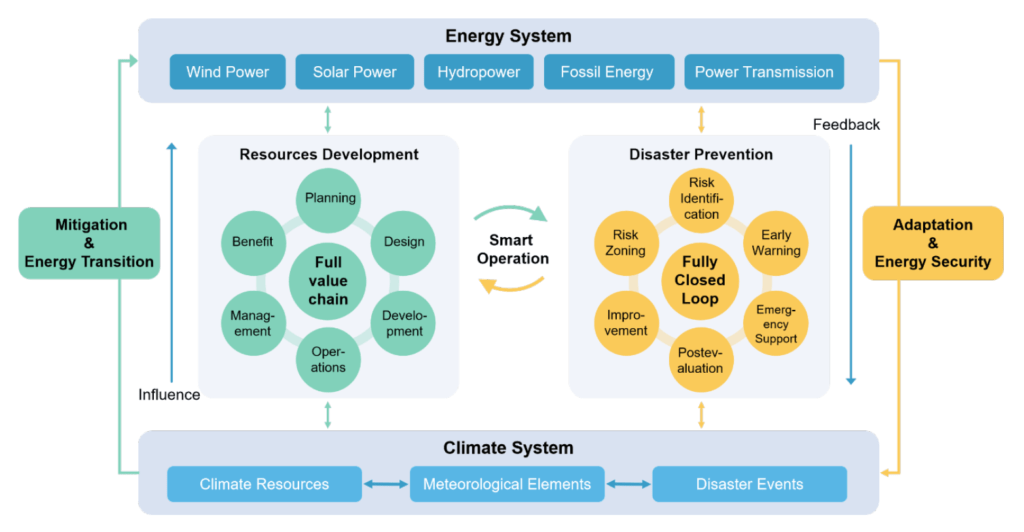
A central feature of this publication is a structured framework to improve meteorological services for the energy sector. The framework builds on three key components:
- Climate change adaptation – providing early warning and disaster prevention services to ensure energy security.
- Climate change mitigation – supporting the shift to green and low-carbon energy through tailored weather and climate services.
- operational efficiency – Integrating meteorological and hydrological services into routine energy sector operations to enhance efficiency and system resilience.
By connecting scientific insights with operational needs, the framework highlights the importance of close collaboration between meteorological services and energy operators. Such cooperation helps co-design solutions that strengthen decision-making across the entire energy value chain.
4. Case Studies and Operational Models from China
The publication showcases a range of operational early warning models currently in use across China, demonstrating how scientific research can be turned into practical tools that protect infrastructure and improve system reliability. These models include:
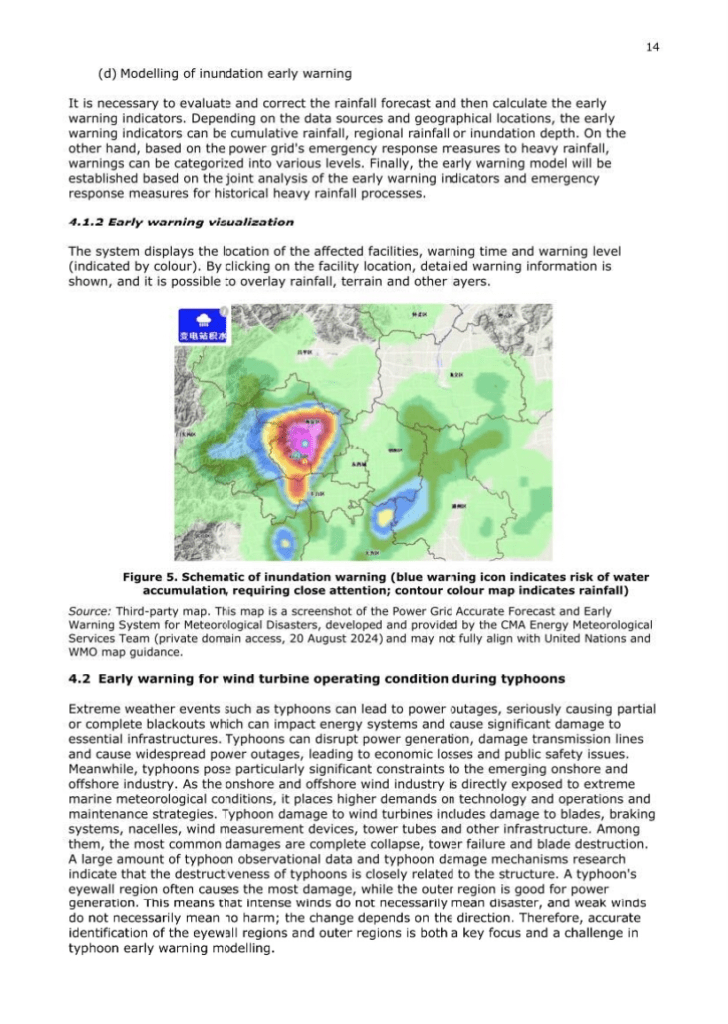
- Inundation warnings for substations and underground facilities
- Typhoon operating-condition warnings for onshore and offshore wind turbines
- Icing warnings for transmission lines and wind turbines
- Power supply shortage warnings that combine weather-driven generation and demand forecasts
These case studies illustrate how impact-based early warning models can be effectively implemented to enhance safety, operational efficiency, and the resilience of energy systems across various meteorological hazards.
Taken together, these findings reaffirm that weather and climate services are fundamental to modern energy planning and essential for advancing clean energy and climate-resilient development. This publication directly supports the Early Warnings for All initiative by equipping countries with practical, energy-specific guidance and adaptable examples.
By combining scientific insights, operational experience, and cross-sector collaboration, it provides a valuable resource for policymakers, engineers, and national meteorological services committed to building secure, sustainable and future-ready energy systems .